Chapter 36 CNJ: CNA’s Own Content Format
CNJ is ordinary JSON. It has no magic bytes, binary primitive layer, 7-bit integer encoding, or shared-resource object graph. The earlier .cnb name was retired precisely because it suggested a binary container. File extension, envelope fields, and type-specific readers provide the contract instead.
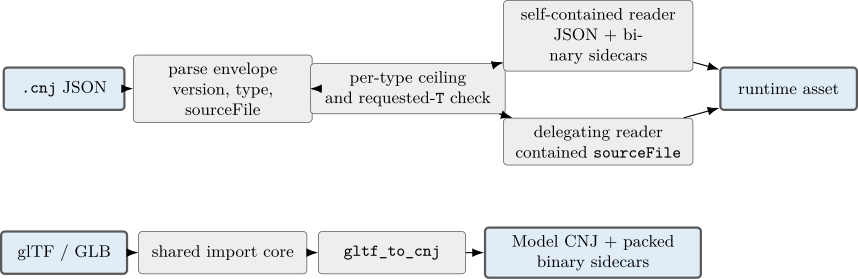
36.1 A small envelope, validated separately
Three top-level fields are recognized before type-specific parsing:
| Field | JSON type | Meaning |
|---|---|---|
| cnjVersion | number | integer format version, bounded by a per-type ceiling |
| type | string | cross-check against the caller’s requested C++ type |
| sourceFile | string | optional delegation to a native file for selected readers |
ParseCnjEnvelope() records failure in parseErrorDetail; it does not throw. Validation is a separate step. The parser retains both the truncated integer and raw numeric value so 1.5 cannot be silently accepted as version 1.
36.2 Version ceilings belong to types
The old documentation’s global cnjVersion == 1 rule is no longer true. ValidateCnjEnvelopeBaseline() accepts a maximum supplied by the reader. Most formats retain a ceiling of 1; Model admits version 2 for its bone hierarchy and per-mesh parent-bone fields. Raising one type’s ceiling does not widen any other type.
Dispatch still begins from the caller’s compile-time T. The envelope’s type field is a cross-check, not a reflection-based factory selector. A request for Load<Texture2D> against a Model envelope fails naming both sides instead of constructing whatever the file asks for.
36.3 Built-in type vocabulary
Current readers recognize Texture2D, TextureCube, Texture3D, SoundEffect, SpriteFont, AnimationClip, Curve, and Model envelopes. The effect reader additionally distinguishes Effect, BasicEffect, AlphaTestEffect, DualTextureEffect, EnvironmentMapEffect, and SkinnedEffect.
That vocabulary is not the same as the native-extension matrix. A Model reader can also accept .gltf and .glb; a texture reader can accept image formats. CNJ is one candidate in ContentManager’s resolution order, not a universal wrapper required around every loose asset.
36.4 sourceFile is a capability, not a convention
Readers fall into two enforced groups:
| Policy | Types | Result |
|---|---|---|
| required delegation | Texture2D, TextureCube, SoundEffect | absence is an error; reader loads the referenced native file |
| self-contained | Texture3D, effects, SpriteFont, AnimationClip, Model, Curve | presence is an error; JSON and declared sidecars own the data |
ResolveCnjSourceFileSafely() rejects an empty path, an absolute path, a component-wise escape after weak canonicalization, a target whose extension is itself .cnj, and a native-looking target that would resolve back to a sibling CNJ through normal selection. The last rule closes an implicit self-cycle, not just the obvious sourceFile: "x.cnj" case.
This containment applies to a reference inside the content document. It does not contradict the top-level ContentManager contract that permits a caller to supply an explicit absolute asset name.
36.5 Two JSON implementations coexist
Newer readers use the recursive-descent CNA::Internal::ParseJson implementation, which has strict number grammar, escape handling, and surrogate-pair support. Older readers still use field-specific substring scanners and manual brace-depth loops. SpriteFont, Model, SkinnedModel, Texture2D color keys, and the custom-GLSL effect branch remain on that legacy path.
The split is visible behavior. A malformed document can be rejected by the real parser while a legacy scanner accepts a partial structure. In particular, the SpriteFont glyph loop stops when it runs out of opening braces, so truncation can yield a partial font rather than a uniform parse error.
Neither path currently has a document-size cap, and the recursive parser has no nesting-depth limit. CNJ therefore lacks the object-depth, string, decompressed-size, and fuzzing boundaries now present on XNB. Chapter 37 treats that asymmetry as an open boundary, not as proof of an exploit CNA’s audit did not execute.
36.6 Custom loaders receive raw JSON
RegisterCnjLoader<T>(typeName, factory) installs a deterministic per-type extension. The factory receives the raw document text and the manager, not a parsed JSON value. Empty names or factories fail, a type that already has a loose reader fails, and duplicate (T,typeName) registration fails rather than silently replacing the earlier factory.
The first custom registration for a type lazily installs a private generic CNJ reader. That reader validates the baseline envelope, then dispatches on the envelope type name. This is the exception where the type string selects among user factories; the outer ContentManager::Load<T> still fixes T.
36.7 Binary sidecars remain format-specific
Plain JSON does not mean every payload is textual. Model and animation content can reference raw vertex/index blobs and .skeleton.bin/.clip.bin sidecars. A bespoke binary reader decodes their fixed layouts. Bone counts are sanity-bounded, while an optional appended skeleton-root block is detected by remaining bytes rather than a tagged field.
That compatibility pattern is useful but fragile: a trailing block can only be distinguished from truncation or a future extension through expected remaining size. New sidecar evolution should prefer an explicit tag/version rather than another implicit length test.
36.8 Production and provenance
The graphics-free gltf_to_cnj developer tool can produce Model CNJ plus sidecars and is built independently of a window or graphics device. Runtime Model loading can also consume .gltf and .glb directly through the same import core, making the offline conversion optional for the common path.
No CNJ file is checked into the pinned CNA source tree; tests generate them in temporary directories. That means parser and envelope behavior has synthetic coverage, while long-term compatibility with a versioned real-world CNJ corpus is not yet established. When shipping CNJ, record the producing tool revision and keep representative assets under version control outside the transient test-only corpus.
36.9 The format in one rule
Treat CNJ as a typed JSON contract whose version, source-file policy, parser, and sidecars depend on the requested asset type. Do not infer safety or evolution rules from the extension alone, and do not describe it as binary merely because some readers own binary sidecars.